Personal protective equipment for Ebola
Infection prevention and control measures include, among other measures: hand hygiene, personal protective equipment and waste management materials.
The Protective equipment consists of garments placed to protect the health care workers or any other
persons to get infected.
These usually consist of standard precautions: gloves, mask, gown. If it is blood or airborne high infections, will include: Face protection, goggles and mask or faceshield, gloves, gown or coverall, head cover, rubber
boots. The characteristics of these products will be described in the sections below.
Link to other Infection Prevention and Control measures.
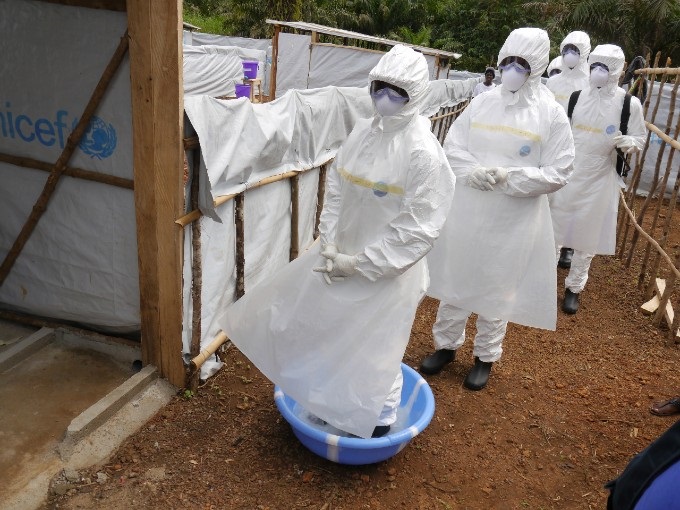
Ebola Outbreak in Sierra Leone, 2014 - Dry run practice at Kagbantaman Community Care Centre. During the dry run, everyone who needed to, put on and took off Personal Protective Equipment (PPE) practiced before strictly enforcing the red zone rules.
Personal protective equipment for Ebola
Due to the urgency of the Ebola outbreak and the WHO’s scale up of international response in west Africa, WHO is providing technical information on appropriate available essential medical devices which are indispensable for treatment centres, community-based units and other preventive activities, in affected and neighbouring countries.
Personal Protective Equipment (PPE) is most important in preventing transmission of the Ebola virus not only in treatment centres but also various activities, e.g. cleaning, waste management and safe burials, and community care related to the outbreak.
On the 31 October 2014, WHO updated the Rapid Advice Guideline for Personal Protective Equipment for Ebola response and the technical specifications of the referred equipments, which can be downloaded below:
Publications
Other relevant documents
/epidemic-and-pandemic-preparedness-and-prevention-(epp)/global-influenza-programme-(gip)/global-respiratory-virus-activity-weekly-update.tmb-144v.png?sfvrsn=8b4f467c_2)
Global Respiratory Virus Activity: Weekly Update N° 563

Sudan: WHO Health Emergency Appeal 2026
Since April 2023, conflict in Sudan has driven one of the world’s most severe humanitarian crises. In 2026, 33.7 million people will require...

South Sudan: WHO Health Emergency Appeal 2026
South Sudan faces overlapping emergencies driven by conflict, climate shocks, displacement and large-scale disease outbreaks. In 2026, 6.3 million...
Innovative Personal Protective Equipment Survey
In order to understand personal protective equipment challenges and to inform innovation related to PPE, if you are a healthcare worker, logistician or procurement specialist with experience in PPE and EVD relief efforts, we kindly request your participation in an online survey found below. Collected responses will serve as a baseline assessment of the global use of PPE for healthcare service delivery in the context of Ebola virus disease (EVD). Please share this link with colleagues who have experience with PPE and EVD relief efforts. Responses will remain anonymous but you may choose to provide contact information should the results from this survey be of interest to you.